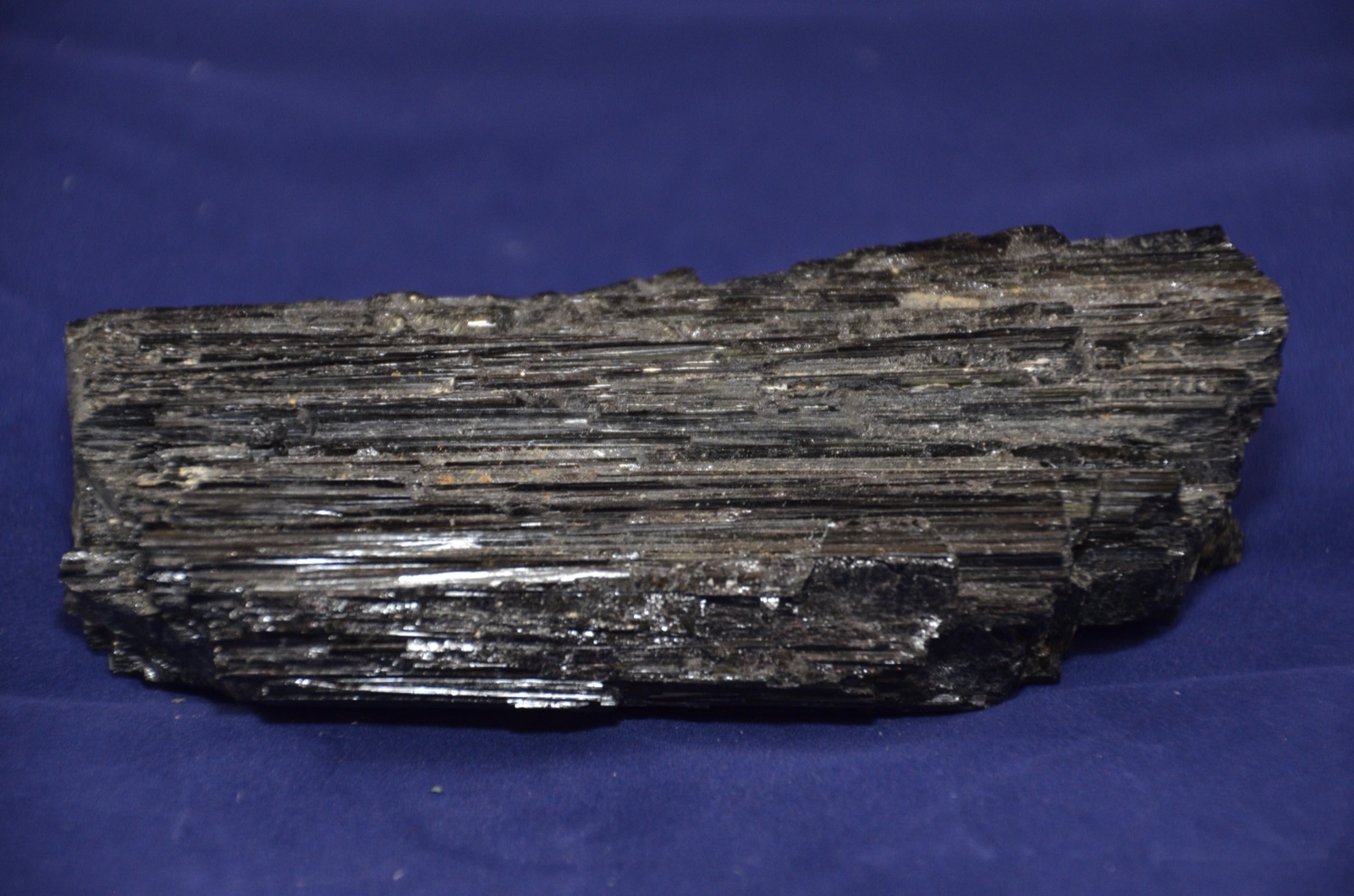
If you have landed here because you keep seeing black tourmaline recommended for protection, EMF shielding from laptops and phones, or grounding when life feels chaotic, you are in the right place. This is one of the most widely used stones in modern crystal practice, traditionally turned to for absorbing what does not belong to you and steadying you when your nervous system is rattled. Below you will find what black tourmaline is, what crystal practitioners actually say it does, how people use it day to day, and a clear-eyed look at where tradition ends and verifiable physics begins.
Quick Answer
Black tourmaline (mineral name: schorl) is an iron-rich silicate traditionally used as a grounding and protective stone. Crystal practitioners associate it with the root chakra and recommend it for absorbing dense or negative energy, easing anxiety, and creating an energetic buffer near electronics, entryways, and the bedside.
Black Tourmaline Meaning and Symbolism
Across modern crystal traditions, black tourmaline is treated as the workhorse protection stone, often the first one people buy. Crystal Vaults describes it as "a powerful grounding stone, electrical in nature, providing a connection between Earth and the human spirit" that promotes self-confidence and a clearer view of the world. Energy Muse frames it as a stone that "shields your energy in a bubble of protection" and absorbs unwanted energy without giving its own away.
Symbolically, the stone stands for boundaries. It represents the right to take up space without being overwhelmed by the moods, demands, or atmospheres of the people and rooms around you. According to Judy Hall's The Crystal Bible, it is said to banish the feeling of being a victim, which is another way of saying it is associated with restoring a sense of personal agency. None of this is a substitute for therapy or medical care, but the symbolism is consistent: black tourmaline is the stone you reach for when you want to feel rooted and shielded at the same time.
Healing Properties and Benefits
The properties below are drawn from established crystal-healing references rather than clinical studies. They describe what the stone is traditionally said to do, not medical outcomes.
Emotional Benefits
Black tourmaline is described by Crystal Vaults as a stone of purification that cleanses the emotional body of "negative thoughts, anxieties, anger, or feelings of unworthiness" and is sometimes used to soothe panic attacks, especially those tied to dark or confined spaces. Tiny Rituals notes its traditional use for easing tension and supporting people through anxious periods. If you tend to absorb the moods in a room, this is the stone most commonly recommended as a buffer. For breath-based support alongside it, many people pair their stone practice with simple breathing exercises.
Physical Benefits
Traditional sources connect black tourmaline with physical vitality, intellectual focus, and emotional stability — Charms Of Light explicitly lists all three. It is also widely used as a sleep-support stone: Tiny Rituals describes it as helping keep nightmares at bay and shielding the sleep space from electromagnetic interference. There is no clinical evidence that the stone itself produces any of these effects in the body. What is reasonable to say is that having a tangible object associated with rest and safety can support a calmer bedtime routine.
Spiritual Benefits
On the spiritual side, black tourmaline is most often described as a grounding tool. The Crystal Council calls it a "transmuter" that converts surrounding negative energy into purified energy and cleanses the auric field. Hibiscus Moon, a crystal educator with a mineralogy background, calls it a primo tool for energetic protection, grounding to the Earth, and clearing dense energy. Practitioners commonly place it on the floor at the start of a meditation to anchor the session before moving into higher chakra work.
Chakra and Energy
Across nearly every major crystal reference — Crystal Vaults, The Crystal Council, Charms Of Light, Tiny Rituals, Hibiscus Moon, Energy Muse — black tourmaline is assigned to the root chakra (Muladhara), the energy center at the base of the spine associated with stability, safety, and belonging. Hibiscus Moon additionally connects it with the Earth Star chakra, a transpersonal energy point located roughly six inches below the feet that is said to anchor the body to the Earth itself.
This is why black tourmaline is the stone people are pointed to when they feel scattered, ungrounded, or "in their head." Element associations vary slightly between sources — most assign it to Earth, while Crystal Vaults uniquely assigns Water energy — but the root-chakra consensus is unanimous. If you want to understand the system the stone is working within, our guide to the chakras is a good place to start.
Zodiac and Birthstone Associations
Black tourmaline is most commonly associated with Capricorn, Libra, and Scorpio. Capricorns are said to appreciate its disciplined, structural energy; Libras for the way it helps repel disharmony from their environment; Scorpios for its compatibility with deep introspective work.
On birthstones, the honest answer is that black tourmaline is not itself a traditional birthstone. Tourmaline as a family is the modern October birthstone, but the representative October stones are usually pink tourmaline or watermelon tourmaline — not the black variety. If you are an October reader looking for "your" stone, black tourmaline shares the family association, but the official birthstone tradition does not single it out.
How to Use Black Tourmaline
Meditation
The most common meditation placement for black tourmaline is on the floor between your feet or held in the left hand (the receiving hand in many traditions). Some practitioners place a piece at the base of the spine while lying down, aligning it with the root chakra. The intention is usually the same: ground first, then go inward. Even five minutes of slow breathing with the stone in contact with your skin is a sufficient practice — there is nothing elaborate required.
Jewelry and Wearing
Worn as a bracelet, pendant, or pocket stone, black tourmaline travels with you through commutes, meetings, and crowded spaces. Crystal practitioners often suggest wearing it on the left side of the body if your goal is to absorb and clear incoming energy, and on the right if you want to support what you are projecting outward — though plenty of people simply wear what is comfortable. Choose tumbled or polished pieces for daily wear; raw chunks tend to snag fabric.
Home and Workspace
Common placements include:
- Beside the laptop, monitor, or router — the classic "EMF" placement, though see the FAQ below for what this claim actually rests on.
- By the front door or on a windowsill facing the street — to create an energetic threshold for what enters the home.
- On the nightstand — for people who use it as a sleep-support stone (Tiny Rituals recommends this for protection against nightmares).
- At the four corners of a room — a grid layout traditionally used to define and seal a workspace or meditation space.
Cleansing and Charging
One important care note: avoid salt and salt water for cleansing black tourmaline. The iron content can corrode over time, which directly contradicts the common "soak in salt water" advice you will see elsewhere. Safer methods include:
- Smoke — pass the stone through sage, palo santo, or frankincense smoke.
- Moonlight — set it on a windowsill overnight, especially around the full moon.
- Sound — a singing bowl, tuning fork, or bell.
- Earth — bury it in soil or a houseplant for a few hours to a day.
- Other crystals — selenite or clear quartz are commonly used as cleansing companions.
Black Tourmaline in History
Black tourmaline has been used in protective traditions for centuries, though much of its modern "ancient lore" is a reconstruction by 20th-century crystal authors rather than a continuous documented practice. What is well attested is that 18th- and 19th-century European natural philosophers were fascinated by tourmaline's electrical behavior. Dutch traders importing tourmaline from Sri Lanka (then Ceylon) in the 1700s called it Aschentrekker ("ash-puller") after noticing that, when warmed in a pipe, the stones attracted and then repelled ash — an early observation of the pyroelectric effect later formally described in physics.
In folk traditions across multiple cultures, dark stones generally were placed at thresholds, worn as amulets, or carried into uncertain situations. Black tourmaline fits cleanly into that lineage of dark-stone protection alongside obsidian, jet, and onyx, even when the specific name "tourmaline" was not used.
Mineralogy and Physical Properties
Mineralogically, what we call "black tourmaline" is the species schorl, a sodium-iron-aluminum borosilicate. Schorl is by far the most abundant member of the tourmaline group — roughly 95% of all tourmaline in nature is the black variety. Its key properties:
- Chemical formula: NaFe2+3Al6(Si6O18)(BO3)3(OH)3(OH)
- Crystal system: Trigonal, typically forming elongated prismatic crystals with vertical striations down the length
- Mohs hardness: 7.0 to 7.5 — durable enough for daily wear, but still chips if dropped on a hard surface
- Color: Brownish-black to deep black, occasionally with a bluish cast
- Color cause: Iron content; iron-bearing tourmalines (the schorl species) are colored black to bluish-black to deep brown by Fe2+ in the mineral structure
Two genuinely interesting physical properties are worth knowing because they show up constantly in metaphysical writing: black tourmaline is both piezoelectric (it generates a small electrical charge when mechanically stressed) and pyroelectric (it generates a charge when heated). These are real, measurable mineralogical facts. Crystal authors including Hibiscus Moon cite them as a "scientific basis" for the stone's energetic effects. The physics is real; whether it has any bearing on EMF protection or human biology is not supported by mainstream science.
FAQ
What is black tourmaline good for?
In crystal practice, black tourmaline is traditionally used for energetic protection, grounding, and absorbing dense or negative energy from environments and other people. Common day-to-day use cases include placement near electronics, by the front door, on the nightstand for sleep support, and on the meditation cushion. Practitioners also reach for it during anxious periods or when they need to set firmer emotional boundaries. None of these uses substitute for medical or psychological care.
How do you cleanse and charge black tourmaline, and is salt or water safe to use?
Salt and salt water are not recommended for black tourmaline. The iron in its composition can corrode over time, dulling the surface and weakening the crystal. Safer cleansing methods are smoke (sage, palo santo, frankincense), moonlight, sound (singing bowls or bells), brief contact with soil, or pairing with selenite or clear quartz. Quick rinses in plain running water are generally fine; prolonged soaking is not.
Where should I place black tourmaline in my home for protection?
The four most common placements are: beside the laptop or monitor, by the front door, on the nightstand, and at the four corners of a room you want to feel "sealed" (often a meditation or work space). The unifying logic is the same — black tourmaline is placed at thresholds and at points where energy enters or accumulates. Pick one or two of these to start. You do not need a stone in every room.
Does black tourmaline really block EMF and radiation from electronics?
This is the claim worth being honest about. Black tourmaline is genuinely piezoelectric and pyroelectric — those properties are real physics. Many crystal authors, including Hibiscus Moon, cite them as the basis for EMF-shielding claims. However, mainstream science does not support the leap from "this stone generates a small charge under pressure or heat" to "this stone absorbs harmful EMF from your phone." If you find that having a stone near your devices supports a more intentional relationship with screens, that is a meaningful effect on its own — without making physiological claims that the evidence does not back up.
Can you wear black tourmaline every day, and which side of the body should it sit on?
Yes, with a Mohs hardness of 7 to 7.5 it is durable enough for daily wear. The traditional convention is to wear absorbing or "receiving" stones on the left side of the body and projecting stones on the right, so a black tourmaline bracelet on the left wrist is the common default. That said, plenty of practitioners ignore the rule and wear what feels right. Take it off in the shower (to avoid soap film and any salt residue) and before swimming in the ocean.
Is it safe to sleep with black tourmaline under your pillow or by the bed?
Yes. The most common placement is on the nightstand or under the pillow. Tiny Rituals specifically recommends it as a sleep-support stone for people who experience nightmares or feel sensitive to electromagnetic activity in the bedroom (Wi-Fi routers, phones charging next to the head). If you are using it for nightmare support, pair it with a calmer pre-sleep routine — a few minutes of slow breathing, a screen-free wind-down — rather than relying on the stone alone.
What is the difference between black tourmaline, black obsidian, black onyx, and jet?
All four are popular dark protective stones, but mineralogically they have very little in common. Black tourmaline (schorl) is a crystalline borosilicate at 7.0 to 7.5 Mohs. Black obsidian is volcanic glass — amorphous, with no crystal structure, around 5 to 5.5 Mohs. Black onyx is a banded variety of chalcedony (a quartz species) at 6.5 to 7 Mohs. Jet is fossilized wood (lignite), much softer at roughly 2.5 to 4 Mohs and noticeably lighter in the hand. Practitioners often treat black tourmaline as the most active "transmuter," obsidian as a mirror that reflects back what you bring to it, onyx as a long-haul stabilizer, and jet as a stone of grief and absorption.
References
Schorl — Wikipedia (mineralogical reference for black tourmaline)
Black Tourmaline — Crystal Vaults Encyclopedia
Disclaimer
The contents of this article are provided for informational purposes only and are not intended to substitute for professional medical advice, diagnosis, or treatment. It is always recommended to consult with a qualified healthcare provider before making any health-related changes or if you have any questions or concerns about your health. Anahana is not liable for any errors, omissions, or consequences that may occur from using the information provided.